Connect with us

Artificial Intelligence

Seekde: A New Age of Intelligent Data Discovery

Published

on

Seekde: A New Age of Intelligent Data Discovery

In the vast digital world where information moves faster than light, one small name has begun to appear quietly yet consistently Seekde. It may sound like a new term, but the idea behind Seekde carries the deep power of discovery, understanding, and connection. Seekde represents a modern movement toward intelligent searching, where technology is designed to understand intent rather than just display results. Seekde stands as a concept that merges the spirit of curiosity with the logic of data.

The Meaning of Seekde

At its core, Seekde means the act of seeking something with precision and empathy. Unlike traditional search systems that only rely on matching words, Seekde carries the idea of understanding human needs, language tone, and emotional context. The word seems to come from the blend of “seek” and “decode,” representing how it tries to uncover hidden meaning inside digital information. The concept suggests that searching is no longer mechanical. It’s emotional, human, and layered. Seekde transforms the normal act of typing a query into a journey of understanding.

Origins and Inspiration

The idea behind Seekde seems to rise from years of digital frustration. Seekde was born out of that chaos. It’s inspired by the wish to make searching intuitive again. The creators of this idea, whether human thinkers or tech innovators, imagined a world where searching feels like conversation, not computation. It draws on human psychology, semantic learning, and contextual AI, but remains centered on the human experience. Seekde, therefore, is both a technology and a philosophy, one that believes in balance between human sense and machine logic.

The Digital Function of Seekde

In the digital ecosystem, Seekde can be imagined as an advanced framework that interprets both structured and unstructured data. It uses layers of linguistic understanding to offer results that make sense, not just results that match. If applied as a platform or system, Seekde can process user requests with contextual sensitivity. It analyzes how people type, what they search for, and what emotional pattern is hidden in their words. For example, if someone types “peaceful music after stress,” a normal search engine would show random playlists. 

The Human Connection in Seekde

Every digital platform that succeeds has one shared trait: it feels human. Seekde’s strength lies in its human-like ability to understand nuance. It reflects how people actually think. Humans rarely search with exact words; they express feelings, half-ideas, or emotional needs. Seekde recognizes this and translates those feelings into meaningful digital results. In that sense, Seekde becomes more than a platform; it becomes a companion. It stands beside the user, decoding emotions hidden behind the words. 

Seekde in the Age of Intelligent Search

Modern search has moved far beyond blue links on a screen. Seekde fits naturally into this new landscape. It doesn’t aim to replace existing tools; instead, it enhances them with meaning. While other systems focus on speed and ranking, Seekde focuses on the accuracy of intention. It may take a few milliseconds longer, but what it delivers is insight rather than clutter. Its framework could easily blend into voice assistants, recommendation systems, or knowledge bases, all working under one philosophy to seek with empathy.

The Architecture Behind Seekde

Every intelligent system is built on a strong architecture. Seekde’s structure can be imagined as a multi-layered web where each layer processes a specific aspect of understanding. The first layer identifies linguistic patterns. It reads how humans form sentences and what emotional weight each phrase carries. The second layer translates that into semantic meaning, mapping each phrase with contextual accuracy. The third layer evaluates the purpose that the user truly wants to know, buy, read, or feel. 

Seekde and the Evolution of Search Culture

Seekde also reflects a deeper cultural change in how we interact with technology. People no longer want machines to act as cold tools; they expect them to communicate with emotional intelligence. Seekde fulfills that expectation. By focusing on empathy and comprehension, Seekde has influenced how people approach learning, communication, and information discovery. The digital generation values connection and meaning, and Seekde provides both in one space. 

The Future Vision of Seekde

The story of Seekde has only begun. As digital systems become more emotional and aware, the principles behind Seekde could evolve into full sensory intelligence systems that not only understand words but also gestures, expressions, and tones. The future Seekde might merge with augmented reality, where the digital and human experience truly blend. Seekde’s journey forward depends on how society balances innovation with humanity. If done wisely, it could become the language of a more understanding internet.

Seeking in Everyday Life

In daily life, the influence of Seekde may not always be visible, but it’s felt. When people find what they were truly looking for after countless failed searches, that’s Seekde’s spirit in action. When a learning platform understands a student’s confusion and offers just the right example, that’s Seekde’s principle at work. It’s about subtly understanding the quiet transformation of confusion into clarity. Seekde turns technology from a tool into a partner. And in that relationship, the digital world becomes warmer, smarter, and more human.

Cultural Reflection of Seekde

The word Seekde also mirrors how modern culture views knowledge. In the past, power came from owning information. Now, power lies in understanding it. Seekde represents this new philosophy of comprehension over collection. Cultures across the world are moving from quantity to quality, from searching to seeking. Seekde captures that shift beautifully, standing as a modern emblem of curiosity with conscience. It unites thinkers, creators, and ordinary users under one shared goal to understand more deeply and to seek meaning with purpose.

Technical Potential of Seekde

From a technical viewpoint, Seekde could combine natural language processing, emotional AI, and cognitive computing. It might use deep neural networks to map emotional context, while machine learning refines results through user feedback. But technology alone cannot explain its charm. What makes Seekde remarkable is not code, but care. It represents a blend of intelligence and empathy that sets the next frontier of the human-machine relationship.

Conclusion

Seekde is not just another digital invention. It’s a concept that represents the evolution of human curiosity in the age of machines. It stands between feeling and logic, emotion and data, heart and code. It’s not just about finding; it’s about seeking with depth. Whether it’s used as a platform, a mindset, or a framework, Seekde symbolizes a bridge between human intuition and digital intelligence. It becomes a movement, a quiet revolution of understanding.

What Is ATFboru? Meaning, Origin, and Innovation

FAQs 

Is Seekde an official company?

Currently, Seekde is more of a coined term with strong branding potential, though it could be developed into a business or platform.

What does Seekde mean?

It combines “seek” to search with “de,” which could stand for discovery, digital environment, or development.

How can Seek-de be used?

It could serve as a search platform, e-learning hub, business network, or lifestyle philosophy.

Why is Seekde unique?

It is concise, memorable, search engine optimized, and suitable for a wide range of industries.

What is the future of Seekde?

If developed, it could become a powerful digital platform bridging search, learning, and innovation.

Continue Reading
Click to comment

Leave a Reply

Your email address will not be published. Required fields are marked *

Artificial Intelligence

Quartist: Quantum Thinking and Artistic Innovation Combined

Published

on

By

Quartist

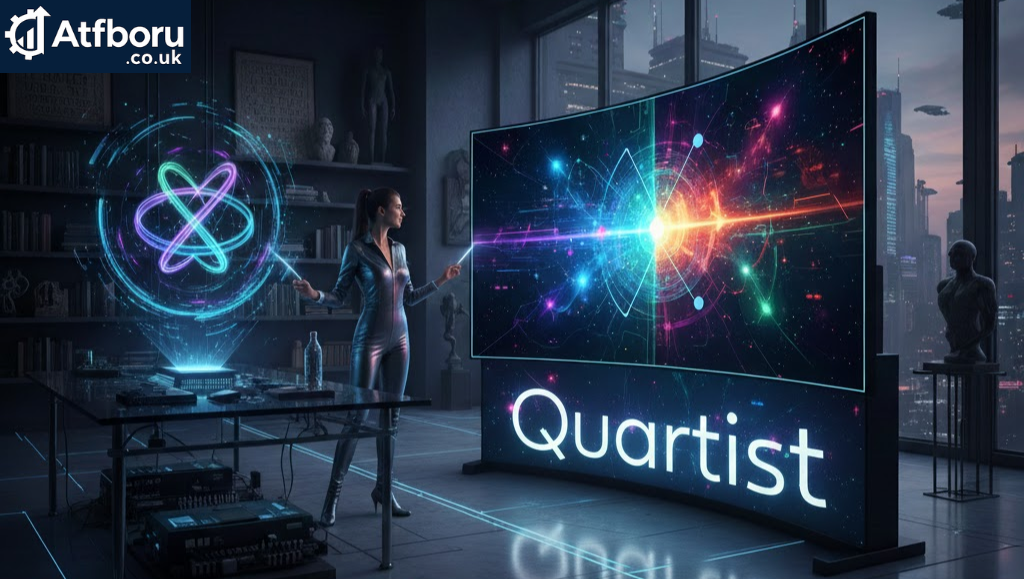
As humanity advances into the realms of quantum physics, digital art, and AI (Artificial Intelligence), a new breed of creators is emerging: the Quartist. This hybrid figure is not confined to the traditional roles of artist, scientist, or technologist. Instead, the Quartist integrates the principles of quantum mechanics, complexity theory, and nonlinear thinking to pioneer novel ways of creating and experiencing reality. This article delves into the Quartist concept, its philosophical implications, and how it is influencing the future of art, technology, and human consciousness.

What Is a Quartist?

A Quartist is an innovative creator who blends the world of quantum mechanics with artistic expression. Drawing inspiration from quantum entanglement, particle physics, and quantum computing, a Quartist uses these complex scientific principles to generate AI-generated art, explore fractal-based art, and create interactive environments. Much like conceptual thinking, their works transcend traditional boundaries, embodying a deep exploration of emergent reality and fluid identity.

Rather than confining themselves to a single medium, Quartists combine digital art, generative music, VR, AR, and algorithmic music to craft multi-dimensional experiences. These creators also leverage quantum time loops and superposition, applying them in artistic and technological realms, often resulting in works that evolve in real-time, based on the viewer’s interaction.

Origins and Evolution of the Quartist Concept

The term “Quartist” has emerged relatively recently, although the conceptual roots trace back several decades. As quantum theory became more widely understood and quantum computing evolved, artists began to integrate these principles into their work. Tools such as Qiskit, IBM’s quantum framework, and software like TouchDesigner and Processing empowered artists to create new forms of art based on quantum algorithms and neural networks.

The evolution of the Quartist concept is a response to the increasing intersection between art, science, and technology. Digital tools like AI, VR, and AR enable creators to build experiences that mirror the principles of quantum physics. The Quartist concept reflects the growing cultural movement that blends cross-disciplinary ideas—art, science, and philosophy—into one unified creative expression.

Core Principles of Quartist Philosophy

Though no formal manifesto defines the Quartist identity, certain principles consistently guide their work. These core ideas echo the complex nature of quantum fields and provide a framework for their creative process:

1. Embracing Uncertainty

Inspired by Heisenberg’s Uncertainty Principle, Quartists view uncertainty as an opportunity for exploration, not something to be avoided. This principle mirrors the ambiguity often found in nonlinear thinking, where the outcome is not predetermined but rather unfolds organically over time.

2. Multi-Dimensional Creativity

Quartists often blend multiple media—digital art, sound, motion, and code—to create works that reflect the complexity of quantum systems. Much like the observer effect, their creations change and evolve based on the interaction between the work and its audience.

3. Non-Linearity

A Quartist’s work often eschews traditional narrative structures. Instead of having a clear beginning and end, their pieces evolve, creating emergent realities where time, space, and meaning become fluid. This mirrors quantum superposition, where multiple possibilities coexist at once.

4. Interconnectedness

Drawing from the principles of quantum entanglement, Quartists explore how everything—ideas, people, and systems—is interconnected. They seek to highlight how subtle changes in one part of a system can affect the whole, much like the interconnectedness of particles in a quantum field.

5. Observer Influence

Just as the act of observation can alter the state of a quantum system, Quartists create works that change depending on the audience’s interaction. Whether through VR or AI-generated art, the observer becomes an integral part of the work, influencing its form and meaning.

Quartist in Practice: Real-World Examples

While the term Quartist is still emerging, many artists and creators are already embodying this concept in their work:

Visual Arts

  • Refik Anadol combines quantum computing and AI to generate immersive art installations that simulate the neural connections of the brain, creating works that echo the patterns found in quantum fields.
  • Julius Horsthuis creates fractal-based VR environments that feel like stepping into a quantum dreamscape, offering viewers a chance to experience the infinite complexity of quantum systems.

Music

Musicians are embracing algorithmic music and generative music techniques to create evolving compositions. These compositions may be influenced by quantum randomness, where quantum algorithms generate unpredictable musical sequences, allowing the sound to evolve in real-time based on mathematical or particle behavior models.

Philosophy & Writing

  • Quantum fiction has gained popularity as writers explore stories that shift timelines, feature characters aware of their quantum selves, and model worlds based on the unpredictability of quantum particles.

Tech and Code

  • Programmers are using tools like Qiskit to develop quantum algorithms that create unpredictable visual outputs and interactive environments. These creations are deeply influenced by quantum cognition, where the mind itself is viewed as a quantum system.

Philosophical Implications of Being a Quartist

Being a Quartist is more than just creating art—it’s a philosophical exploration of reality and identity. Much like quantum mechanics, which challenges our understanding of the universe, Quartists push the boundaries of how we think about creativity, time, and the self:

Reality as Construct

Quartists often view reality as fluid and malleable, akin to quantum fields. Their work invites the audience to reconsider what is real and what is illusion, drawing parallels to the fluctuating nature of quantum systems.

Self as Observer

Just as particles exist in multiple states until observed, Quartists explore the fluidity of identity. They embrace the idea of the self as mutable and evolving, much like the observer effect in quantum physics.

Timelessness

Many Quartist works explore quantum time loops and the collapse of linear time. These pieces may evolve forward, backward, or simultaneously, reflecting the superposition of states found in quantum mechanics.

The Future of the Quartist Movement

As quantum computing advances and AI becomes more integrated into creative processes, the Quartist movement is expected to grow. The convergence of quantum-inspired education, decentralized networks, and the rise of metaverse spaces will empower more creators to explore the intersection of science and art. Here are some future possibilities:

  • Quartist collectives will likely build shared metaverse spaces where creators from around the world can collaborate on quantum-inspired projects.
  • New hybrid careers like Quantum Experience Designer or AI-Empowered Creative Synthesist will emerge as more creators use AI and quantum computing to push the boundaries of creativity.
  • Quantum-inspired education models will merge art and science from an early age, fostering a new generation of creators who are comfortable navigating both the scientific and artistic realms.

Quartist vs. Artist: What’s the Difference?

The key difference between a Quartist and a traditional artist lies in their approach to creativity. While traditional artists work within defined boundaries, Quartists integrate science, technology, and philosophy into their creative process. A Quartist’s work is often nonlinear, multi-dimensional, and interactive, challenging traditional notions of art and identity.

Common Misconceptions About the Quartist Concept

Despite the growing influence of Quartists, there are still many misconceptions surrounding the concept. Here are a few common misunderstandings:

  • Quartists are just tech enthusiasts: While technology is integral to a Quartist’s work, their creations are deeply rooted in philosophical inquiry and artistic expression.
  • Quartists only create complex, digital works: While digital art plays a significant role, Quartists may also create tangible works that challenge the viewer’s perception of reality.
  • Being a Quartist requires scientific knowledge: While knowledge of quantum mechanics can enhance a Quartist’s work, creativity and imagination are just as important.

Defining Traits of a True Quartist

A true Quartist embodies the following traits:

  1. Interdisciplinary Expertise: They blend art, science, and technology in innovative ways.
  2. Embracing Complexity: Quartists thrive in complex, evolving environments and embrace the uncertainty inherent in quantum systems.
  3. Innovative Thinking: They challenge the norms of traditional creativity, seeking new ways to express ideas.
  4. Philosophical Inquiry: Quartists engage deeply with the philosophical implications of their work, questioning the nature of reality, time, and identity.

How a Quartist Works: Process and Methods

The process of creating as a Quartist is dynamic and fluid. Here’s how they typically work:

  1. Idea Exploration: Quartists begin by exploring complex scientific and philosophical concepts, such as quantum entanglement or complexity theory.
  2. Integration of Technology: They use tools like AI, quantum computing, and VR to bring their ideas to life.
  3. Experimentation: Quartists experiment with various media, combining digital art, sound, and code to create works that are multi-dimensional.
  4. Audience Interaction: Many of their works change based on the interaction of the audience, much like the observer effect in quantum physics.

Examples and Case Studies of Quartist Projects

Notable examples of Quartist projects include:

  • Refik Anadol’s AI-driven art installations that combine quantum computing and neural networks.
  • Julius Horsthuis’s VR fractal environments, which offer an immersive experience that mirrors quantum fields and superposition.

Becoming a Quartist: Practical Steps to Get Started

To become a Quartist, follow these steps:

  1. Study Quantum Concepts: Gain a basic understanding of quantum mechanics, complexity theory, and quantum computing.
  2. Learn New Technologies: Familiarize yourself with tools like Qiskit, TouchDesigner, and Processing.
  3. Experiment with Different Media: Create works that combine traditional and digital art, generative music, and interactive environments.
  4. Collaborate with Other Creators: Engage with artists, scientists, and technologists to broaden your creative horizons.

Conclusion

The Quartist represents a new frontier in creativity—one where science, philosophy, and art converge. By embracing uncertainty, exploring quantum principles, and challenging traditional notions of identity and time, Quartists are redefining what it means to create. As the world moves further into the digital and quantum age, the Quartist movement will continue to inspire and shape the future of creativity.

FAQs:

What is a Quartist?
A Quartist blends quantum thinking, digital art, and creativity across various mediums.

What are the core principles of Quartist philosophy?
Embracing uncertainty, multi-dimensional creativity, non-linearity, interconnectedness, and observer influence.

Who are some famous Quartists?
Refik Anadol and Julius Horsthuis are prominent Quartists known for their quantum-inspired art.

What makes Quartists different from traditional artists?
Quartists integrate science, technology, and quantum principles into their creative work.

Can anyone become a Quartist?
Yes, anyone interested in merging art, science, and technology can become a Quartist.

What tools do Quartists use?
They use AI, quantum computing, and software like Qiskit, TouchDesigner, and Processing.

Continue Reading

Artificial Intelligence

HMS Photovoltaik: Smarter Solar Power Solutions

Published

on

By

HMS Photovoltaik: Smarter Solar Power Solutions

HMS Photovoltaik is a solar technology system that refers to an innovative development by the company HMS, which specializes and advanced  Photovoltaik solutions. HMS Photovoltaik adjusts its strategy for both small-scale projects and large-scale projects for commercial installation. In practice, HMS Photovoltaik is designed for dormitory and industrial applications of solar power, more adaptable to evolving energy demand. Photovoltaik technology with endurable and modular design goals, HMS Photovoltaik plays a key role in promoting greener energy solutions, aiming the reduce fossil fuels.

Key points

  • Uses high-efficiency solar modules.
  • Smart energy management system.
  • Reduces energy loss and boosts output.
  • Supports clean, renewable energy goals.

How HMS Photovoltaik Works?

HMS Photovoltaik Works by converting sunlight into electrical energy through advanced solar technology. High-efficiency solar panels consisting of photovoltaic cells, which collect sunlight and employ an electric current to excite electrons, make up this system. An inverter is used to transform direct current (DC), a power source, into alternating current (AC), which is appropriate for both residential and commercial use. The intelligent technology provides efficient automation and energy savings at reduced cost to HMS Photovoltaik through clean and reliable solar energy.

The Evolution of HMS Photovoltaic Technology

To understand HMS Photovoltaik, it helps to look at the broader history of solar innovation:

  • Modular design: The flexible and scalable system design for various applications.
  • Material improvements: Introduction of high-efficiency film materials for power generation and longevity.
  • Global expansion: Across different industries and countries, establishing HMS in clean energy innovation.
  • Eco Efficiency: Focused on reducing carbon emissions and promoting power alternatives.

This evolution represents a shift from simple solar generation into an intelligent, connected, and energy ecosystem that supports the global clean energy goals.

Importance of HMS Photovoltaic Features

The future of HMS Photovoltaik’s system plays a vital role in modern solar energy.2025 solar environment model in the series, such as HMS-300w-1 T and HMS 500-1T, interlock to a single maximum power point tracking (MPPT), helping capture energy even when partially shaded. These systems are also designed to reduce carbon emissions and lower dependence or non non-reliable energy sources. They are resistant are tough conditions for 25 years with an IP67 water and dust rating, Hoymiles 2025 specification.HMS Photovoltaik is a reliable, efficient, and eco-friendly solution for the future of clean energy.

The Science of Photovoltaik Technology

Photovoltaic technology works on a simple but powerful idea, turning sunlight into electricity. This current is then collected and used to power homes and businesses and even entire communities. This electricity in the form of direct current is then changed into alternating current through an inverter for powering homes, offices, and machines.HMS Photovoltaik applies this basic principle and pushes it further with technological adventures. 

Conclusion

HMS Photovoltaik is a solar technology system that refers to an innovative development by the company HMS, which specializes and advanced  Photovoltaik solutions. An inverter is used to transform direct current (DC), a power source, into alternating current (AC), which is appropriate for both residential and commercial use.2025 solar environment model in the series, such as HMS-300w-1 T and HMS 500-1T, interlock to a single maximum power point tracking (MPPT), helping capture energy even when partially shaded.HMS Photovoltaik applies this basic principle and pushes it further with technological adventures. Photovoltaik technology with endurable and modular design goals, HMS Photovoltaik plays a key role in promoting greener energy solutions, aiming the reduce fossil fuels.

Trucofax: The New Era of Smart Transparency

FAQs

What is HMS Photovoltaik?

HMS Photovoltaik is a solar technology system that refers to an innovative development by the company HMS, which specializes and advanced  Photovoltaik solutions. 

Is the cost of HMS Photovoltaik high?

Once installed, it can save your power expenses for years, although it can be quite expensive.

Can HMS Photovoltaik operate in the absence of sunlight?

 Even though it mostly depends on sunlight, it may still use stored energy to generate power at night or in cloudy situations.

Can my entire home be powered with HMS Photovoltaik?

You can, indeed. It can easily power your complete house with the correct configuration and battery storage.


Continue Reading

Artificial Intelligence

xai770k: What You Need To Know

Published

on

In the rapidly evolving world of technology, new terms often emerge that can be confusing or unclear. One such term gaining attention is xai770k. Whether you are a tech enthusiast, developer, or business professional, understanding xai770k—its meaning, applications, benefits, and challenges—is essential.

This guide provides a comprehensive overview of xai770k and explores how it may shape the future of artificial intelligence and machine learning.

Contents

  • What is xai770k?
  • The Birth of xai770k: Historical Context
  • Applications of xai770k
    • Healthcare
    • Customer Support
    • Content Creation
    • Financial Services
  • Advantages of Using xai770k
  • Challenges and Considerations
  • The Future of xai770k
  • Conclusion

What is xai770k?

xai770k refers to a next-generation machine learning model designed for advanced natural language processing (NLP) tasks. It integrates principles of explainable artificial intelligence (XAI) to ensure that its decision-making processes are transparent and interpretable by humans.

The “770k” likely indicates the model’s architecture size—approximately 770,000 parameters—striking a balance between efficiency, accuracy, and explainability. This makes xai770k ideal for real-world applications that demand both performance and accountability.

The Birth of xai770k: Historical Context

The development of xai770k is rooted in the broader evolution of artificial intelligence. Early AI models in the 20th century were simple and rule-based. The rise of deep learning in the 2010s enabled more complex and powerful models, but they also became harder to understand.

This lack of transparency led to a growing need for explainable AI (XAI) systems that not only make decisions but can explain them. xai770k represents a step forward in this direction, making AI more accessible, trustworthy, and usable across sensitive domains like healthcare and finance.

Applications of xai770k

The versatility of xai770k makes it applicable across many industries. Here are some major use cases:

1. Healthcare

xai770k can analyze patient records, medical histories, and symptoms using NLP. It supports doctors in making accurate diagnoses by providing transparent explanations for its suggestions, increasing confidence, and improving outcomes.

2. Customer Support

By integrating xai770k into chatbots and virtual assistants, businesses can improve how they handle customer inquiries. The model’s explainable outputs help agents and systems deliver better responses while maintaining clarity and consistency.

3. Content Creation

Writers and marketers can use Xai770k to generate blogs, emails, advertisements, and social media content. Its ability to explain content choices (such as tone or style) enables users to refine their messaging for better engagement.

4. Financial Services

In finance, xai770k assists with risk assessment, fraud detection, and market analysis. Its explainability ensures compliance with regulations and helps analysts understand the reasoning behind predictions and trends.

Advantages of Using xai770k

Adopting Xai770k offers several benefits over traditional AI models:

Enhanced Understandability

xai770k provides clear, human-readable explanations for its decisions, making it easier for non-technical users to trust and utilize AI.

Better Decision-Making

By revealing the logic behind its outputs, xai770k empowers users to make smarter, data-driven decisions.

Increased Trust and Adoption

Transparency builds trust. xai770k’s explainability encourages adoption in fields where accountability is critical, such as medicine and finance.

Iterative Improvement

User feedback on xai770k’s performance can be used to enhance and retrain the model, leading to continuous improvements in accuracy and usefulness.

Challenges and Considerations

Despite its strengths, xai770k comes with some challenges:

Complexity of Implementation

Deploying xai770k requires technical expertise and infrastructure. Organizations may need to train teams or partner with AI specialists.

Balancing Performance and Explainability

Highly accurate models are often complex and difficult to interpret. xai770k tries to balance these priorities, but maintaining both can be challenging.

Ethical Considerations

Like all AI systems, xai770k must be used responsibly. This includes protecting user data, addressing bias, and ensuring fairness across all applications.

The Future of xai770k

As demand for explainable AI grows, xai770k is well-positioned for widespread adoption. Ongoing research and development will likely lead to more powerful versions that offer even better performance and transparency.

In the future, we can expect xai770k and similar models to play a key role in making AI not just smarter, but more ethical, reliable, and user-friendly.

Conclusion

xai770k represents a major leap in the AI and machine learning landscape. By combining powerful NLP capabilities with explainability, it opens the door to smarter, more transparent AI applications across industries.

Understanding XAI770k is crucial for anyone in the tech field, from developers and data scientists to business leaders. It not only improves decision-making but also ensures that technology remains trustworthy and aligned with human values.

As artificial intelligence continues to grow, models like xai770k will shape the way we interact with machines, helping us make better decisions, build trust, and create more responsible technologies.

Continue Reading

Trending